Emotional distance
We Feel Like Roommates, Not a Couple — Why
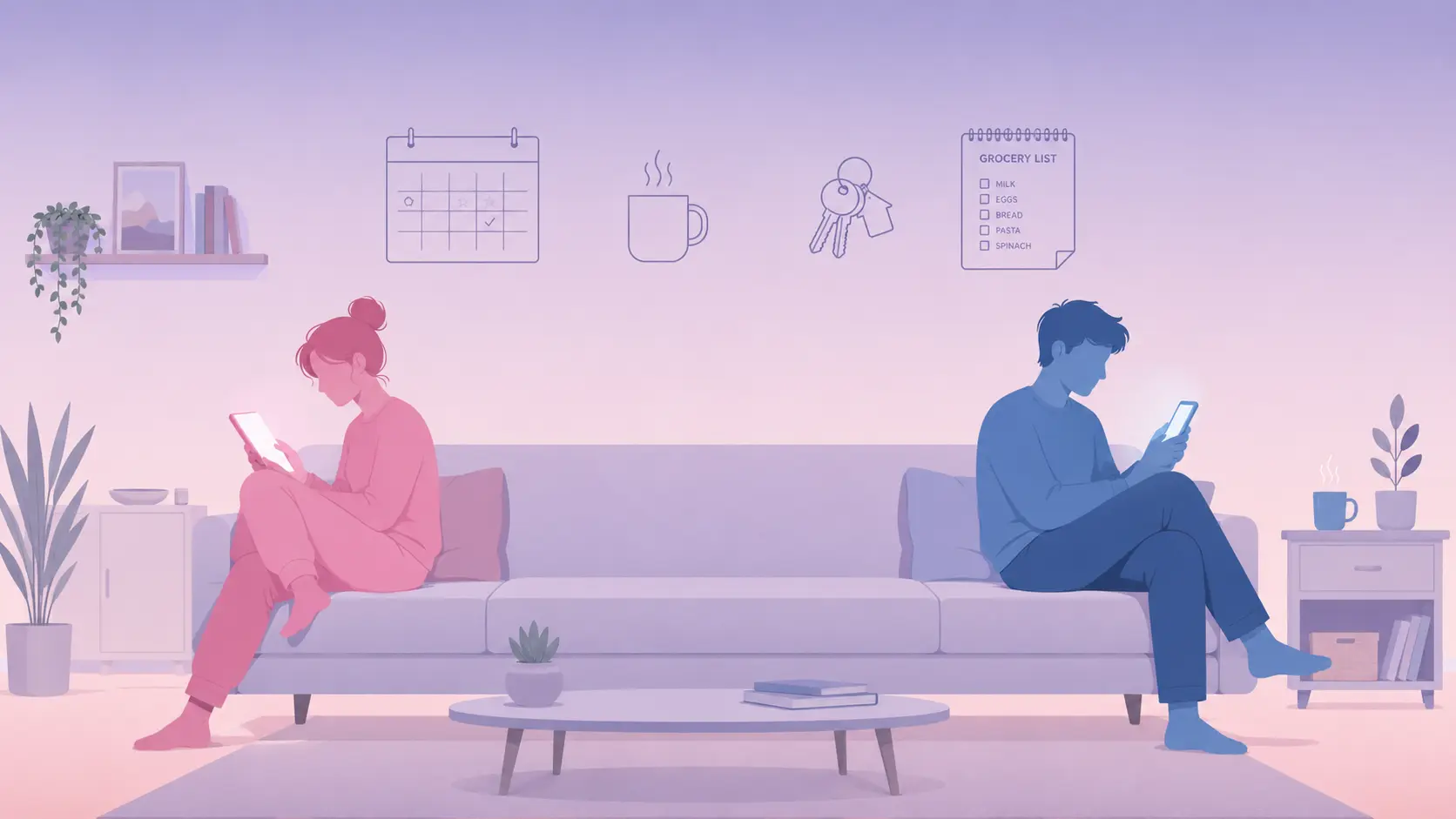
You share a calendar. You split the grocery run, the dishes, the rent or the bills, the "who's picking up dinner" text. The logistics of your life together run smoothly. And that's exactly the part that's confusing, because nothing is technically wrong. You're not fighting. You're not cold to each other. You just can't remember the last time he looked at you like more than the person he coordinates the week with — the last unprompted kiss that wasn't a goodbye, the last conversation that wasn't about scheduling. You feel like roommates, not a couple.
That gap between "everything functions" and "nothing sparks" is real, and you're not imagining it or being dramatic for naming it. Feeling like roommates is a specific mode of relating, not a character flaw or a sign you're ungrateful for a stable partner. And here's the part most articles skip: roommate mode is almost always one of four distinct things, and they don't get fixed the same way. Below is how to tell which one you're actually in — including the single fastest test you can run tonight.
What "feeling like roommates" actually means
Feeling like roommates means your relationship has slid into functional-but-flat coexistence: the practical machinery works, but the romantic charge is gone. Concretely it shows up as four things — conversation that's mostly logistics, touch that's routine or absent, lives that run in parallel instead of together, and a kind of apathy where you stop bothering to fight because it doesn't feel worth it.
Notice that none of those is "we hate each other." That's what makes it so hard to point at. You can be perfectly polite, even fond, and still be roommates. The romance hasn't been replaced by conflict — it's been replaced by neutrality. This is the named sub-pattern people are describing when they say your relationship feels emotionally distant: roommate mode is the specific version where the distance has settled into a comfortable, transactional routine that neither of you actively disrupts.
The four components rarely all arrive at once. Usually one leads — most often the conversation going logistics-only — and the others follow as the emotional temperature drops.
Is feeling like roommates a sign the relationship is over?
Usually not by itself. Feeling like roommates is a mode, not a verdict. It describes how the relationship currently feels, not where it's permanently headed. Plenty of couples pass through a roommate stretch during a hard season and come back out of it once the pressure lifts and someone reaches across the gap on purpose.
What it is, reliably, is a signal worth reading — because roommate mode is stable. It doesn't tend to resolve on its own the way a single bad week does. Relationships can coast in this state for a long time precisely because nothing forces a reckoning. So the honest answer is: it's not the ending, but it's also not nothing. Whether it becomes the ending depends almost entirely on which of the four causes is driving it, which is what the rest of this comes down to.
Feeling like roommates is usually one of four things — here's how to tell which
The reason "we feel like roommates" advice so often misses is that it treats the symptom as one problem with one fix. It isn't. The same flat feeling can come from four very different places, and the distinguishing question isn't what does it feel like (it feels the same) — it's how did it get here and who's feeling it.
If you want help placing your specific situation against these four patterns instead of guessing, the relationship quiz walks you through it.
1. A comfort/contentment plateau (recoverable)
The most benign cause: you got comfortable. Early on, every interaction carried novelty and a low-grade thrill of uncertainty. Once that uncertainty resolves into trust, the nervous-system buzz fades — and a lot of couples mistake the absence of buzz for the absence of love. It fades first in the automatic moments, which is why a greeting that no longer lights up the way it used to is usually routine rather than a verdict. The tell here is that the warmth is still accessible the moment you reach for it. Plan something out of routine, and he meets you there. The romance isn't gone; it's just stopped happening automatically. This is the difference between being comfortable and being roommates: in a comfort plateau, the spark is dormant and responsive. In roommate mode proper, reaching for it gets you a polite non-response.
2. One of you is mid-withdrawal — and the other hasn't noticed
Here, "we feel like roommates" is actually "he checked out, and the flatness is the residue." This is the cause that disguises itself best, because withdrawal is quiet. He didn't announce anything. He just gradually stopped initiating the non-logistical stuff — the texts that weren't about pickup times, the questions about your day, the reaching for your hand — and the relationship reorganized around his lower engagement. You adapted to the new baseline without clocking that it was a new baseline. If that's the read, the roommate feeling is downstream of something more specific, which is worth understanding on its own terms — see why you feel disconnected from your partner. The distinguishing question: did this fade evenly between you, or did you slowly stop getting met?
3. Shared stress or life-load suppressing the romantic mode
Sometimes neither person has pulled away and there's no plateau — you're both just buried. A demanding job stretch, a family crisis, a health thing, a money squeeze, sheer exhaustion. When survival mode kicks in, the brain triages romance first, because romance feels optional when logistics feel urgent. A newborn is the most extreme version of this, and the hardest to read from the inside — if the flatness arrived with the baby, it helps to read the difference between new-parent depletion and real withdrawal before you assume either one. The tell: you can trace the flatness to a roughly identifiable start — a new job, a move, a hard few months — rather than a slow erosion with no clear origin. And crucially, the fondness is intact underneath; you're not avoiding each other, you're both just running on empty. This kind of roommate mode tends to lift when the load does, if you don't let the temporary routine harden into the permanent one.
4. Genuinely fading interest
The cause people fear most, and the rarest of the four as a standalone explanation. This is when roommate mode isn't a phase or a side effect but the early shape of one person quietly disengaging from the relationship itself. The difference from cause #2 is degree and direction: withdrawal can be reached and reversed; genuine fading interest is when attempts to reconnect are met not with friction but with indifference — a shrug, a "we're fine," a subtle relief at the distance rather than discomfort with it. If repeated, sincere bids to close the gap keep landing on flat ground, that's the signal that matters. Feeling like roommates can be a sign it's over — but only when this is the cause, and the others have been ruled out first.
The fastest test: do both of you feel like roommates, or just you?
This is the single most useful question, and almost no article asks it. Roommate mode feels symmetrical from the inside — but it usually isn't. There's a world of difference between two people who both miss the spark and have just stopped reaching for it and one person who feels like roommates while the other feels totally fine.
If you're both quietly grieving the same lost closeness, you're on the same team facing a shared problem — that's cause #1 or #3, and it's the most recoverable position there is, because the wanting is mutual. If it's only you — if he seems genuinely content with logistics-and-coexistence and you're the only one aching for more — that asymmetry points toward cause #2 or #4, and it changes everything about what comes next. The asymmetry isn't a measure of who is wrong. It's a measure of whether the desire to reconnect is shared, and that's the variable that actually predicts whether roommate mode reverses.
You can run this test tonight without a confrontation: name the feeling out loud, lightly — "I feel like we've been more like roommates lately" — and watch the shape of the response. Recognition and a little sadness mean he feels it too. Defensiveness or blankness mean he might not — and that's information, not an accusation.
To map whether the flatness is mutual or one-sided and what that means for your specific situation, take the relationship quiz.
Signs you're roommates and not a couple
Roommate mode shows up as a cluster of small, concrete shifts rather than one dramatic change. The clearer signs:
- Conversation is almost entirely logistics — schedules, chores, bills, errands — and rarely drifts into anything personal, curious, or playful.
- Touch has gone routine or absent — the goodbye peck survives, but spontaneous, non-functional touch has thinned out, and less affection in the relationship is something you'd struggle to date the start of.
- You live in parallel — same roof, same calendar, but separate evenings, separate attention, separate inner lives that no longer overlap much.
- Conflict has gone quiet, not because you agree but because disagreeing doesn't feel worth the energy — apathy where there used to be friction.
- You can't remember the last real "us" moment — not a logistics win, an actual moment of feeling like a couple rather than a household.
- Effort feels one-directional or paused — the small bids to connect have thinned out, from one of you or both.
- You feel a little lonely in his company — present together, but not with each other.
A single item here means little. Four or five of them holding steady for weeks is what "feeling like roommates" actually is.
Can a relationship come back from feeling like roommates?
Yes — conditionally, and the condition is which of the four causes you're in. A comfort plateau (cause #1) comes back the most easily; the spark is dormant, not dead, and deliberately reintroducing novelty and undivided attention usually reawakens it. Stress-suppressed roommate mode (cause #3) tends to recover once the load lifts, provided you don't let the survival-routine calcify into the permanent default. Withdrawal (cause #2) can come back, but it requires the withdrawn partner to actually re-engage, not just tolerate proximity — which means the conversation has to happen. Genuine fading interest (cause #4) is the one where "coming back" depends on whether the interest can be rekindled at all, and sometimes the honest answer is that one person is already gone.
The reason the asymmetry test matters so much is that it predicts this directly: when both people want the closeness back, the odds are good regardless of cause; when only one does, the work is harder and the outcome less certain. And it's worth saying plainly — you might be reading this to figure out how to repair it, or you might be reading it to figure out whether to. Both are legitimate. Naming that you feel like roommates doesn't obligate you to a repair plan; it just gives you an accurate read to decide from.
If you're trying to tell whether this is recoverable or whether you're already deciding something bigger, the quiz gives you a clearer read on where things actually stand.
Common questions about feeling like roommates, not a couple
Why do my boyfriend and I feel like roommates?
Usually because the relationship slid into logistics-only coexistence — and it's typically one of four causes: a comfort plateau, one of you quietly withdrawing, shared stress suppressing the romantic mode, or genuinely fading interest. They feel identical from the inside but reverse very differently. The fastest way to narrow it down is whether you both feel it or just you.
What's the difference between being comfortable and being roommates?
Comfort means the spark is dormant but responsive — reach for connection and your partner meets you there. Roommate mode means reaching gets a flat or polite non-response, and the relationship has reorganized around logistics with little emotional pull underneath. Comfort still feels like a couple at rest. Roommates feels like two people running a shared household with the romance switched off.
Why does he feel like a roommate and not a partner anymore?
Most often he's quietly withdrawn — stopped initiating the non-logistical things (the texts, the questions, the reaching for you) until the relationship reorganized around his lower engagement and you adapted without noticing. Less often it's shared stress flattening you both, or fading interest. The tell: ask whether the warmth fades evenly between you, or whether you slowly stopped getting met.
What are the signs you're just roommates and not a couple?
Conversation that's almost all logistics, touch gone routine or absent, parallel lives under one roof, conflict replaced by apathy rather than agreement, no recent moment of feeling like an actual couple, thinning effort, and a quiet loneliness in each other's company. One sign means little. Four or five holding steady for weeks is what roommate mode really is.
Key takeaway
Feeling like roommates, not a couple, is a real and specific mode — functional logistics with the romance switched off — but it's a mode, not a verdict on the relationship. It's almost always one of four things: a recoverable comfort plateau, one partner quietly withdrawing, shared stress suppressing the romantic gear, or genuinely fading interest. The single most clarifying question isn't what it feels like — it's whether you both feel it or only you. When the wanting to reconnect is mutual, roommate mode is highly recoverable. When it's one-sided, that asymmetry is the real signal worth paying attention to.
Keep exploring this topic
Continue reading in Emotional Distance in a Relationship or return to Relationship Signals & Patterns.